
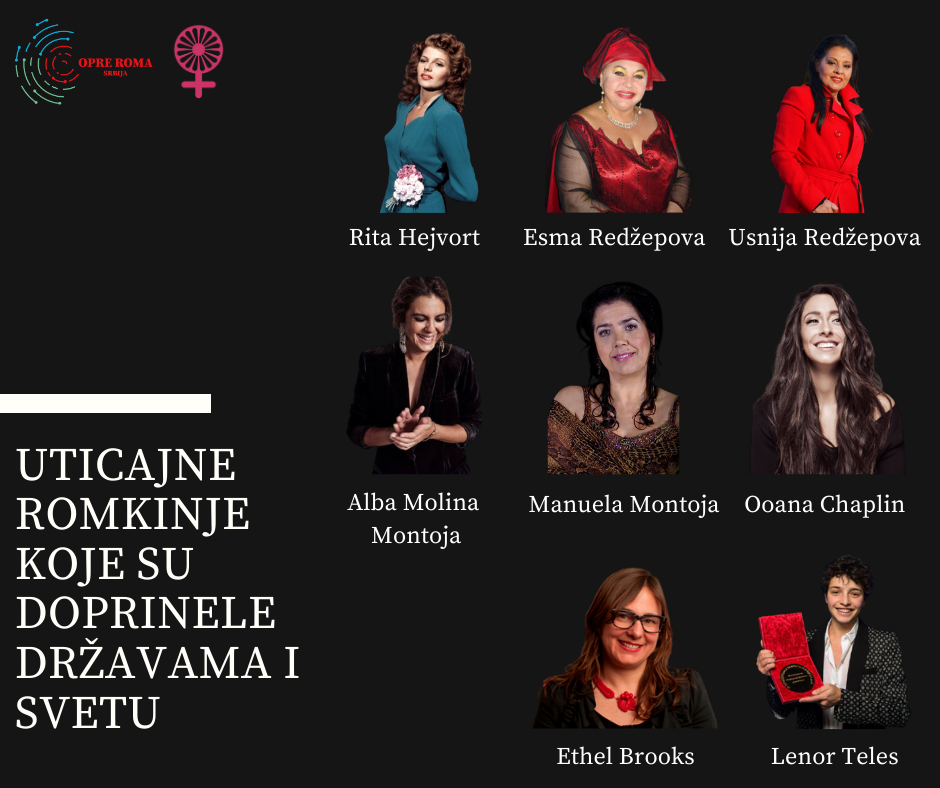
Influential Roma women who contributed to countries and the world
Woman. A woman was consistent with her dreams. A woman is weak and feeble. A woman was consistent with her goals. A housewife. A strong and ambitious woman. The woman takes care of the house and the family. A woman was consistent in her career. Woman mother. A businesswoman. Each of these items represents a woman.
If we look at the history of Roma women, starting with the migration of Roma from India in 1400, we can notice that Roma women were already inclined to develop their careers through music and dance. Although women were housewives, mothers, and protectors of their families, there was one thing that set Roma women apart from other women in society. The women of that time were brave and expressed their feelings through music and dance. Flamenco is known as a dance that dates back to the migration of Roma from India. The dance represented freedom for Romani women, a dance in which Romani women expressed their sorrow and pain. Recognizable cassocks, long dresses, and rhythmic music were for the Roma women their escape into another reality in which they left sadness and pain behind.
Today, flamenco is characteristic of Spanish Roma who continues to build the history of this dance. Today, many Spanish Roma women are building their careers on flamenco, they are successful women who continue to build the culture and tradition of this dance. One of the most famous artists of this dance and singing is the Spanish Roma woman Alba Molina Montoya. Alba is an artist, singer, and flamenco dancer. She released her first solo album more than 15 years ago. She grew up in a musical family and believes that music is a part of her. As Alba says, it is very difficult to define flamenco because it is very thin, it is easier to listen to music and feel what she wants to say than to describe it in words. Despite her career, Alba does not forget her Roma roots and her belonging to the Roma community. She claims that prejudices against Roma are still present in society and that there is still great disrespect for Roma's culture, so by her example, she breaks down all prejudices and continues to develop tradition and culture through music and dance. Her mother is also an example Manuela Montoya who is a famous singer and dancer of flamenco music. In the seventies, she actively performed with her husband under the name Lole y Manuel, where the most famous flamenco artists of that time were. Their performances are still known today for the strength of the message, emotions, and deep connection with music and the Roma tradition that they have nurtured for decades. They have publicly declared themselves as Roma, where they have had their flamenco roots for centuries, and they express their attachment to the Roma community through music and dance. Their flamenco is honest, positive, and pure, they mixed poetry and music, and so they break down prejudices towards the Roma community in the seventies in the whole of Spain at that time.
Roma is known for its competencies and talents in art, dance, music, and acting. Little is known that the Roma community is also rich in Hollywood actresses who have completely changed the world with their works of art. Their films are still a masterpiece and a great contribution to Hollywood cinema. In 1937, Hollywood got one of the best Hollywood actresses, Rita Hayworth, who signed a contract with Colombia Pictures. She was known as a fiery redhead who breaks down all stereotypes about the Roma community of the time. She had a total of 71 roles in Hollywood cinema. Her most famous films are Gilda, Cover Girl, The Lady from Shanghai, etc.…
Ooana Chaplin, the granddaughter of Charlie Chaplin, is today an English-Spanish actress, dancer, and ballerina who publicly, like her grandfather, declared herself a Roma woman. She began her career in 1988 when she got her first role in the film Incocenciva. This actress became famous in the role of the most-watched series Game of Thrones, where she plays Talisu Stark. Ana also became famous in the series The Crimson Field, which is broadcast on the BBC. So Ana has a career behind her of a very successful Romani woman, where Hollywood recognized her as an artist worthy of being a part of Hollywood cinema.
Leonor Teles is the youngest winner of the Golden Bear in Berlin in 2016, for the shortest film that describes the life of Roma in the form of a fairy tale. This young director from Portugal called the film "The Ballad of a Frog", whose goal is to present the Roma people as a community that cannot go unnoticed by the majority population. The description of her film reads: "Once upon a time before humans came along, all beings were free and could be with each other. All the animals danced together and were immensely happy. Only one was invited to the celebration - a frog. In her rage at the injustice, he committed suicide. "One thing Roma and frogs have in common is that they will never be seen or remain unnoticed." At the age of 24, Leonor Teles managed to do something that no one has ever done before, and that is to attract attention, with her short film on the life of Roma in the world today.
In addition, it is very important to mention Roma artists from the Balkans who further emphasize their connection with the Roma community. These are artists like Esma Redžepova and Usnija Redžepova who have a career of great Yugoslav artists behind them.
Esma Redzepova showed that a Romani woman can have a great and successful career, and at the same time be realized in the role of a mother. Unfortunately, she never managed to fully fulfill that role, but she did raise a total of 70 Roma children. She actively participated in their education, and most of them were attracted to learning and love for music, as well as their breadwinner, that is their mother as they called her. Esma was one of the richest women, but a woman who was rich in the love of her large family, rich in her successful career, and rich in her songs that describe the hard life of Roma women and the early marriages of girls. Although she had a great career behind her, Esma returned to her community with her songs, humane work, and encouraging all women that the fight must never stop.
Usnija Redzepova is an artist who was engaged in music. Many connect the kinship of Esma and Usnija, but it is interesting that they did not know each other before signing the contract for the then production company Jugoton. Before signing the contract in 1966, Usnija studied and graduated in Arabic at the University of Belgrade. However, so academically educated, her love for music did not prevent her from trying out in those waters. In 1973, Usnija Redzepova got a role that will mark her career. In the film, Kostana got the lead role and her career began to develop further. Usnija is a Romani woman who shows that education and art go together, that Romani women are strong and independent women, and breaks down all stereotypes about Romani women who play the role of housewives throughout their lives.
Ethel Brooks is a Roma woman and a professor at Rutgers University, where she teaches women's and gender studies and sociology. Behind her is a book on Roma women's feminism. She is engaged in research on political economy, social movements, and globalization. She believes that these topics are the least oriented towards the Roma and that additional scientific work on this topic should be done. That is why she wrote a book on the topic of Roma women's activism, advocates for women's Roma rights, and additionally warns the world about violence against Roma in the world. Ethel contributes to the advancement of the Roma community in the true sense, and said, she focuses on women's Roma feminism and the poor social and economic situation of the Roma community around the world. Her books and scientific works show that Roma women are beings who can do anything, who achieve their goals, and the care that has been innate in them for centuries encourages their care for the Roma community and the creation of a better word for it.
Each of them has created and is creating a better world for the Roma community and the state. Roma women have contributed and continue to contribute not only as housewives but also as artists, scientists, workers.
International Women's Day is a day when women stood up for their rights, a day when they realized that they could fight for their right to vote, a day when the kitchen became a choice and not a necessity! Romani women, our compatriots, show that the voice of Romani women is valuable, it is strong!