
Man musn’t tell where woman belongs
I am a woman. They say I origin from Adam s rib. I am fickle, evil, lying, and at the same time weak, fragile, immature, gentle. Because I m a woman, I need to get beat every 40 days because of the devil and the malice that exist in me. Because I m incapable, I have to stay in the house to clean, iron, cook and babysit, anyway I was born for that, my life certainly has no other meaning. Even if my partner takes pity on me and gives me chance to get a job i have to do low-paid jobs, I must stand out too much jeopardize the credibility of men. I must not neglect my housework because of my paid job, because I am a woman and that will mean that I am not a good housewife. And if for that or any other reason my husband slaps me, pushes me, beats me, he should because I deserved it.Every third woman has experienced physical violence. On a sample of 119 women, 78,2% have experienced psychological violence. In Serbia, every 7 to 10 days one woman is killed in domestic violence.To this date, Serbia has adopted more than three laws and measures concerning the prevention and protection of women against violence and domestic violence. Although each of them legally protects women and their rights, in everyday life patriarchal values and practices are affirmed and nurtured.Patriarchy means the rule of a man and respect for tradition. It is based on the fact that a woman is subordinate to a man and the younger ones are subordinate to the older ones. Although when you see this definition, it seems impossible that it exists in the modern age, put on your gender glasses and answer the following questions: What are the jobs that men do and what jobs women do? What do we think of a man who does the housework? What is the name of a woman who has had multiple partners and what is the name of a man? And even to go to the banalest thing like the question: How many female characters are on paper bills and how many are male?Now that we have clarified what patriarchy means, let us return to the topic of violence against women. This problem is very difficult to identify and confirm. It has become our everyday life and normalcy, something that can even be “deserved”, often without considering the consequences it leaves behind. Violence is not only physical when you beat someone and bruise them, but it is also verbal, psychological, economic, social, sexual.Although violence is known, on the level that it exists, the way in which violence is talked about and how it is “justified” is part of the ruling culture of society. It is important to mention that what happens in the family is a feature of the political culture that is nurtured in the state. A state in which citizens want a leader and who is paternally inclined will reduce such patterns of behavior to the family level. The more democratic and modern the state, the more family relations will be, but also gender relations. Of course, when it comes to the state organization, one should have an insight, in addition to culture as one of the dimensions, there is the legal, economic and wider political aspect. A democratic state also has a positive attitude towards national minorities and respect for human rights.Why do we mention this? When it comes to violence against women, Roma women are often forgotten in that demographic picture. Roma women are not trusted when they talk about violence, violence is attributed to Roma culture and tradition. Institutions approach this problem full of prejudices and stereotypes, although everyone says in principle that violence is a bad thing. Roma women in Serbia are not only on the margins because of their nationality but also because of their gender.Realizing the existence of that problem and unequal treatment, the “Opre Roma Srbija” movement decided to conduct research on the occasion of “16 days of activism in the fight against violence against women.” We want to show the tragic picture that our Roma women face and also one of the reasons for their weak political participation.The research consists of 50 respondents who filled out an online survey from 05.12.- 08.12. The distribution channels were: the Opre Roma Srbija movement page, women s Roma groups, individual shares on Facebook.These are some of the most important data we gathered.When asked if they can recognize violence, 92.7% of women answered that they can, while the rest were not sure. As the most common forms of violence, they mentioned primarily physical and psychological violence, and three respondents mentioned economic, sexual, and social violence. When asked if they know a woman victim of violence, 85.4% gave an affirmative answer! In 87.5% of cases, women answered that the most common perpetrator of violence against women is a partner or husband, and the rest stated that it could be anyone. Such a large number of answers associated with a marital partner is precisely an indicator of the existence of a patriarchal ideology. The husband is the one who commands and the wife listens and is silent.And not only do they know the woman who experienced violence and who is the most common perpetrator, but every third Roma woman has experienced some kind of violence!Every other Roma woman has experienced a man catcalling her!Every fifth Roma woman was ridiculed and belittled by her partner in front of others!Every fourth Roma woman was forced by her partner to do something without her will!Every fifth Roma woman has been beaten and slapped by her partner!These are some of the most important data from our research. We believe that these data show you the reality of everyday life that Roma women live. When you say that Roma women do not have the capacity for some jobs, do not have the knowledge, are not motivated, or do not deserve something, keep this information in mind.In this regard, it is necessary not only to acknowledge that there is a problem but also to work on solving it. We believe that the right answer to this position of Roma women is a political organization. All the rights that we women have today are part of the historically difficult struggle of women before us. Women sacrificed their lives, went on hunger strike, protested so that we have the right to vote today so that we could be part of the public sphere today so that we could get out of the kitchen. It is up to us to continue that fight, our problems today are also problems that our ancestors could not solve. The issue of violence is not only a matter of women but also of all citizens of the state and can be solved by joint feminist action through the four factors of every state. The most commonly used instrument for solving this problem is raising awareness, ie emphasizing that the problem exists and that it should be talked about. However, talking about the problem does not solve it because that problem is embedded in a set of some factors. If we look at the legal framework we can see that the forms of violence are not clear enough nor how each form of violence is punished and confirmed. Violence is not criminalized enough in our laws, there is no harsh condemnation because it is still proclaimed in our tradition. To this, it should be added that there is no specific law that talks about violence against Roma women as a special category because the factors that exist when talking about violence among the majority population are not the same with the Roma community. Also, numerous studies have shown that raising awareness has no effect if a woman is not economically empowered and financially stable. A large number of women suffer violence precisely because they have nowhere to go because the situation is bad with their parents as well. And of course, all this has to go through the main political currents. On the political scene, the laws that protect a certain group of citizens are actually passed in the parliament. Women make up more than 50% of the population of states and their political participation in places where their rights are decided is important.A man cannot pass laws on abortion. A male judge cannot judge rapists. The male director cannot decide on maternity leave. A man cannot tell a woman where she belongs.I am a woman. I am free to choose my profession. I have an equal chance to advance in the business. I decide on my body and how I dress. I am politically active and I fight for respect for my rights and the rights of others. I am hard-working. I deserve to be equally respected and esteemed. I am strong and I do not give up. I am potential!
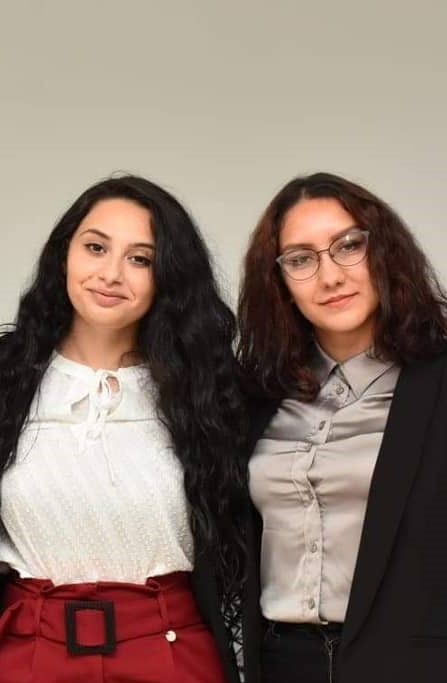
Authors: Andrijana Mikulović and Jelena Reljić
Mentor: Mensur Haliti