
Do Romani women have same life chances to employ as others?
Romani community in Serbia suffers numerous prejudice of public and decisions makers which leads us to inadequate strategies, proposals, actions plans and other state mechanisms whose role is to answer to the needs of Roma community, besides other the problem of employment. Assuming that Roma do not want to work but receive social benefits, it seems that this priority has never been worked on systematically, but through some ad hoc or short-term activities such as public works. In this context of misunderstanding, ignoring the needs of a national minority, when you see the position of Romani women, we can conclude that it is more challenging than both the majority population and Roma men.
There are numerous legal acts that affect employment and guarantee the right to free choice of jobs and conditions of employment that are not discriminatory, but when it comes to the implementation of the acts is missing. Even a document such as the Strategy for the Social Inclusion of Roma men and women emphasizes the employment of the Roma community. The measures envisaged by this document, in the field of employment policy, aim to encourage the inclusion of able-bodied Roma men and women in the formal labor market, improve employability, employment and self-employment, with special focus on Roma men and women who belong to the category of hard-to-employ unemployed. However, this "improvement of employability" does not occur. When it comes to Romani women and employment, few people mention the role of Roma women in the family, which can be an obstacle to working outside the household.
In this regard, the Opre Roma Serbia Movement has launched a research aimed at examining the position of Roma women in the labor market, ie when looking for work. Do Roma women have the same life opportunities to get a job as others? Can a Roma woman decide on her life?
The research was conducted at the end of October 2021 online with a sample of 90 women. 75 women filled out an online questionnaire while 15 women underwent a telephone interview. The respondents are from all parts of Serbia: Zajecar, Kikinda, Doljevac, Aleksinac, Alibunar, Belgrade, Leskovac, Bor, Kragujevac and other cities. The women ranged in age from 50 to 18 years. Most were women who were 1992, 1998 and 1985 years born.
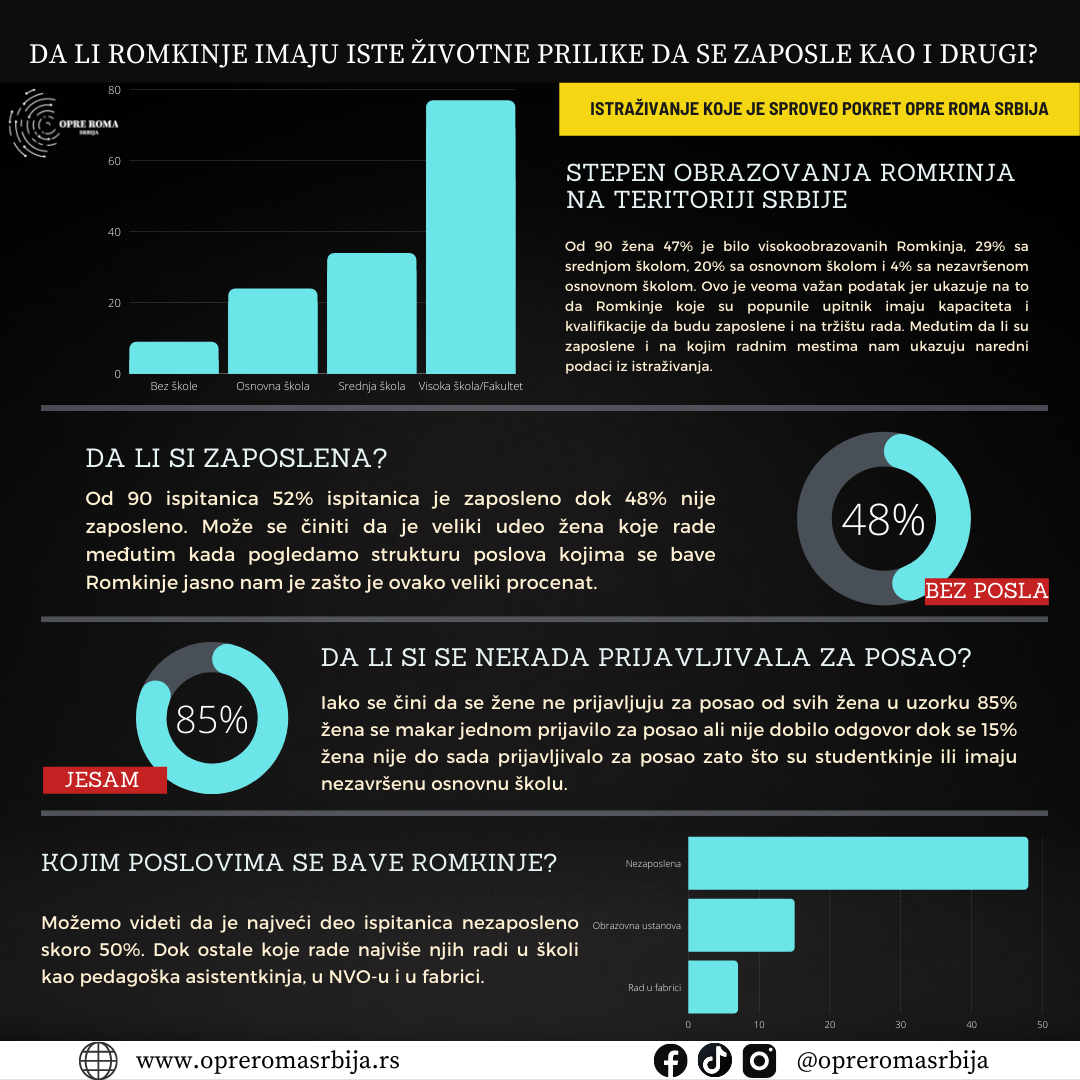
Of the 90 women, 47% were highly educated Roma women, 29% with secondary school, 20% with primary school and 4% with incomplete primary school. This is a very important fact because it indicates that Roma women who filled out the questionnaire have the capacity and qualifications to be employed in the labor market. However, the following data from the research indicate whether they are employed and in which jobs.

Out of 90 respondents, 52% are employed while 48% are not employed. It may seem that a large share of women work, however, when we look at the structure of jobs that Roma women do, it is clear to us why such a large percentage.

We can see that most of the respondents are almost 50% unemployed. While the others who work, most of them work at the school as a pedagogical assistant, in an NGO and in a factory. Although it seems that women do not apply for a job out of all women in the sample, 85% of women applied for a job at least once but did not receive an answer, while 15% of women have not applied for a job because they are students or have not finished primary school. We can assume that some of these women also never looked for a job because of their domestic role in the family.


In the chart below we can see what are the biggest challenges that Roma women see when looking for a job. As many as 56% of Romani women believe that their employer does not want to hire a Romani woman. 33% of Romani women say that employers employ Romani women exclusively in low-paid positions. 12% of Roma women think that the employer does not want to hire a married woman and 11% that the factories are far from the woman's place of residence.

In addition to the challenges that exist on the Roma woman's business journey, there are also obstacles in the family itself, whether wider or narrower. Of all respondents, 37% of Roma women said that they had challenges in education due to their traditional family.

The biggest challenge for more than half of the respondents is that their parents did not have the financial resources to educate them. 16% of respondents say that parents did not see the importance of girls going to school, 13% of respondents say that in their family a woman is preparing to be exclusively a housewife, and 10% that as a Roma woman she cannot get a job and therefore did not go to school. Other respondents stated that they had problems at school by peers and teachers while the rest of the respondents said there were no challenges.

In addition to these data, in the end we left space for Roma women to add something that they think is important for this topic, and we will show you four most impressive statements.
Statements by Roma women:
Roma women 1: Mostly Roma women characterize us only for lower-ranking jobs, they behave accordingly, I feel powerless because I can do a lot of things in various fields.
Roma Women 2: The challenges faced by a Roma woman are first, first in a family where she is not gender equal with her brothers, later in school where she is discriminated against and then when looking for a job because she is discriminated against being a Roma woman and then a woman.
Roma woman 3: I am not recognized as a capacity.
Roma women 4: Women face employment challenges, Roma women even more so. Fueled with patriarchy, the next level if they have a husband who is traditional. Then taking care of the children and understanding that it is the woman who should give up her job or career. As far as employers are concerned, Romani women are not represented in service activities precisely because of employers' fear that they will not have enough customers if it is known that Romani women work there.
We can conclude that Romani women, on the one hand, are under pressure from domestic work, and on the other hand, there are employment challenges and employers who are not willing to provide an opportunity. Although it is often said that Roma women do not want to do with this research we can say that they really want to, but that it is necessary to give them a chance.
Employing a Roma woman does not only mean individual well-being for her in the sense that she will have health insurance, a pension later, a bigger budget for herself and her family. We can see this in the broader context that the employment of Roma women also means a contribution to the family economy and the economic growth of the state.
Why it is important for Romani women to have jobs?
1. Contribution to the family - if a Roma woman is employed besides her partner, or only her, it means a lot for the household budget and the development of children's abilities in the family. It will be easier for children to go to school, they will be able to choose school, extracurricular activities. Also, the family will live better, in better home conditions, generally a better standard of living.
2. Acquiring a pension - everyone's age is falling hard. Romani women in almost all cases receive a family pension or social assistance that is minimal. Working in youth will mean a safe old age, as well as "taking off the burden of the state".
3. Creating business opportunities for other Roma women - the more Romani women are employed, the more business opportunities they will open up for others, as they will introduce employers to the potential of Romani women.
4. Contribution to the economic growth of Serbia - an employed Roma woman will contribute not only to her family but also to the Serbian economy in general by having a salary. First of all, we will have a family less living of social income, which means lower state expenditure, on the other hand, the fact that a Roma woman is employed means that she gives part of her salary as a contribution to the budget, from which money is later distributed to other state institutions. employment rate and thus the standard of living in Serbia.
Society must be ready to use the capacity of Roma women for the common good and we as a Roma community should be ready to support Roma women on their path to realizing their potential.